Arushi Nath. My abstract, Orbital Stability of Closely Spaced Many-Planet Systems, has been accepted as a poster at the American Geophysical Union (AGU) Annual Meeting 2026 (AGU26), which takes place […]
Arushi Nath.
My abstract, Orbital Stability of Closely Spaced Many-Planet Systems, has been accepted as a poster at the American Geophysical Union (AGU) Annual Meeting 2026 (AGU26), which takes place from 7 to 11 December 2026 at the Moscone Center in San Francisco. I will present the poster on Thursday, 10 December 2026, from 08:30 to 12:00 in the South Poster Hall (Hall ABC), in session ED41C: BRIGHT STaRS (Bright Students Training as Research Scientists) Poster Session.
I am the first author. My co-authors are Jack J. Lissauer (NASA Ames Research Center), Katelinn Ohrtman (South Dakota School of Mines and Technology), Aarushi Mehrotra (Walter Payton College Preparatory High School), Andrew Wayne Smith (Bangor University) and Bennet Outland (Stevens High School).
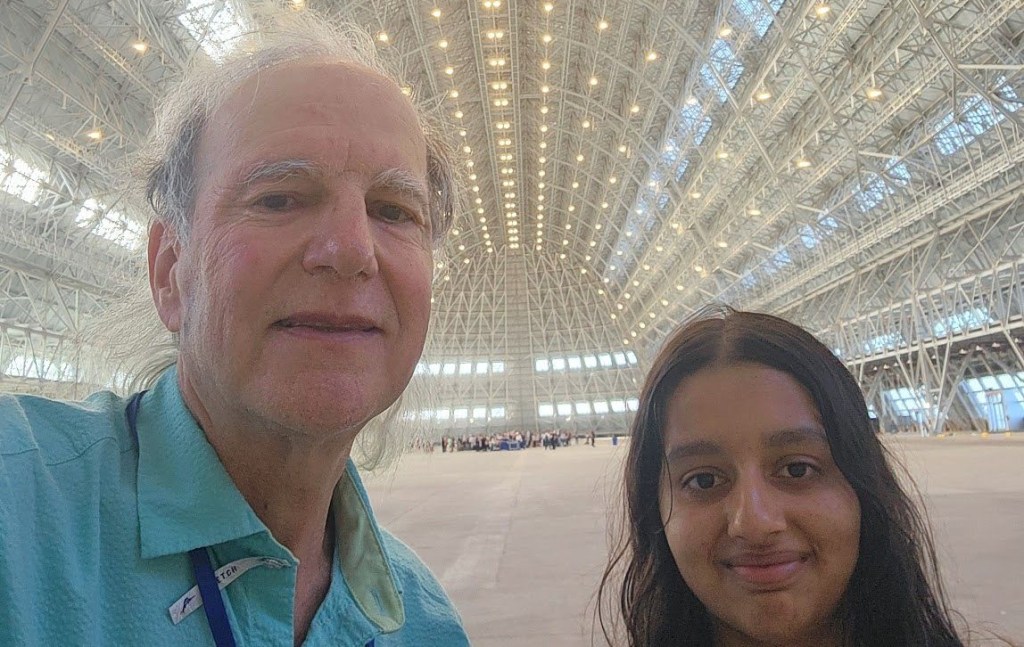
With Jack Lissauer (NASA Ames Research Center), my co-author on the AGU 2026 abstract, in Hangar One during the NASA Exploration Science Forum poster session, July 2026.
The Question
NASA’s Kepler and TESS missions have shown that compact multi-planet systems are common: several planets often orbit within a small range of distances from their host star. Whether such tightly packed systems can survive for billions of years places a constraint on how planetary systems form and evolve. Earlier numerical studies focused on compact systems with up to five planets, so the stability of systems with more planets is less well understood.
What We Did
We studied idealised compact systems of six or more equal-mass planets orbiting a solar-mass star. The planets start on circular, coplanar orbits, with the same period ratio between every pair of neighbouring planets. Using the WHFast symplectic integrator in the REBOUND N-body code, we integrated these systems for up to 1010 years and measured how a system’s lifetime depends on the spacing between planets, the number of planets, the starting orbital longitudes and mean-motion resonances.
What We Found
System lifetimes generally increase exponentially as the spacing between neighbouring planets increases, consistent with earlier work on systems with fewer planets.
Adding more planets tends to reduce the average lifetime, even beyond eight planets, although the effect becomes smaller as the number of planets grows.
First-, second- and third-order two-planet resonances produce clear dips in lifetime. They are most destabilising when the resonant planets are neighbours or are separated by only a few planets.
At wider spacings, we found additional drops in lifetime that do not correspond to any two-planet resonance. This suggests that resonant interactions among more than two planets can influence the stability boundary of compact planetary systems.
Together, the results show that whether a tightly packed exoplanet system survives depends on the combined effects of spacing, the number of planets and the resonant architecture.
How This Connects to My Earlier Work
This project applies the N-body simulation approach I developed for NEPTUNE, my exoplanet prediction project that received a Third Grand Award at the 2025 Regeneron International Science and Engineering Fair (ISEF). NEPTUNE uses simulations of planets tugging on each other to predict planets that have not been seen directly. Here, the same kind of simulation is used to measure how long packed systems remain stable.
2026 Third Place, Student Oral Competition, NASA Exploration Science Forum, USA. 2025 Third Grand Award, International Science and Engineering Fair, USA. NASA Group Achievement Award 2025 (DART mission team). 2024 Youth Can Innovate Award ($7,000) and Silver Medal, Canada-Wide Science Fair. Gloria Barron Prize for Young Heroes 2024. Eureka Changemakers Fellow 2025. 2023 Second Prize Winner – European Union Contest for Young Scientists (EUCYS). Best of the Fair Award, Gold Medal, Top of the Category, Youth Can Innovate, and Excellence in Astronomy Awards at Canada Wide Science Fair 2023 and 2022. RISE 100 Global Winner, Silver Medal, International Science and Engineering Fair 2022, Gold Medal, Canada Wide Science Fair 2021, NASA SpaceApps Global 2020, Gold Medalist – IRIC North American Science Fair 2020, BMT Global Home STEM Challenge 2020. Micro:bit Challenge North America Runners Up 2020. NASA SpaceApps Toronto 2019, 2018, 2017, 2014. Imagining the Skies Award 2019. Jesse Ketchum Astronomy Award 2018. Hon. Mention at 2019 NASA Planetary Defense Conference. Emerald Code Grand Prize 2018. Canadian Space Apps 2017.
Follow Us on Twitter
Do it Yourself Asteroid Astrometry using Python for Asteroid Apophis
The Masked Scales; 2020 NASA SpaceApps COVID-19 Challenge Global Winners!
Deep Space Musical: NASA SpaceApps 2018 Toronto Winner
LIGO Quadruple Pendulum: Swinging to Stability, Royal Astronomical Society of Canada 2019
TVO Kids (2018): TRAPPIST-1 Sound and Light Model
Lecture on TRAPPIST-1 at Carr Astronomical Observatory (CAO) Open House
Yes I Can / Oui Je Peux: NASA – Canadian SpaceApps Toronto 2017 Winner
Drop the Drought : NASA Space Apps Toronto 2017 Winner