The Los Angeles Planetary Defense and Asteroid Exploration Mini-Conference 2024, organized by the American Institute of Aeronautics and Astronautics (AIAA) Los Angeles Section, was held on June 29, 2024. This […]
The Los Angeles Planetary Defense and Asteroid Exploration Mini-Conference 2024, organized by the American Institute of Aeronautics and Astronautics (AIAA) Los Angeles Section, was held on June 29, 2024. This hybrid event, hosted at the Lawndale Library in Lawndale, CA, gathered nearly 60 participants, both online and in-person. The conference was scheduled on the eve of Asteroid Day (30 June) – a United Nations-sanctioned day dedicated to raising public awareness about the risks and opportunities of asteroids.
Key Presentations
The conference featured an array of speakers giving talks on the following themes:
1. Awareness and Education
International Asteroid Day: Highlighting global efforts to raise awareness about asteroid impact hazards.
2. Planetary Defense Missions
NASA’s DART Mission: Detailing the first mission to demonstrate asteroid deflection using a kinetic impactor.
Planetary Defense Concepts from USC and ISU: Discussing preliminary concepts from the USC and International Space University.
3. Asteroid Exploration and Research
Bennu Asteroid: Insights from the OSIRIS-REx mission, which extensively studied this near-Earth asteroid.
Twenty Years of Bennu: From Arecibo to Orbit (and on to Apophis).
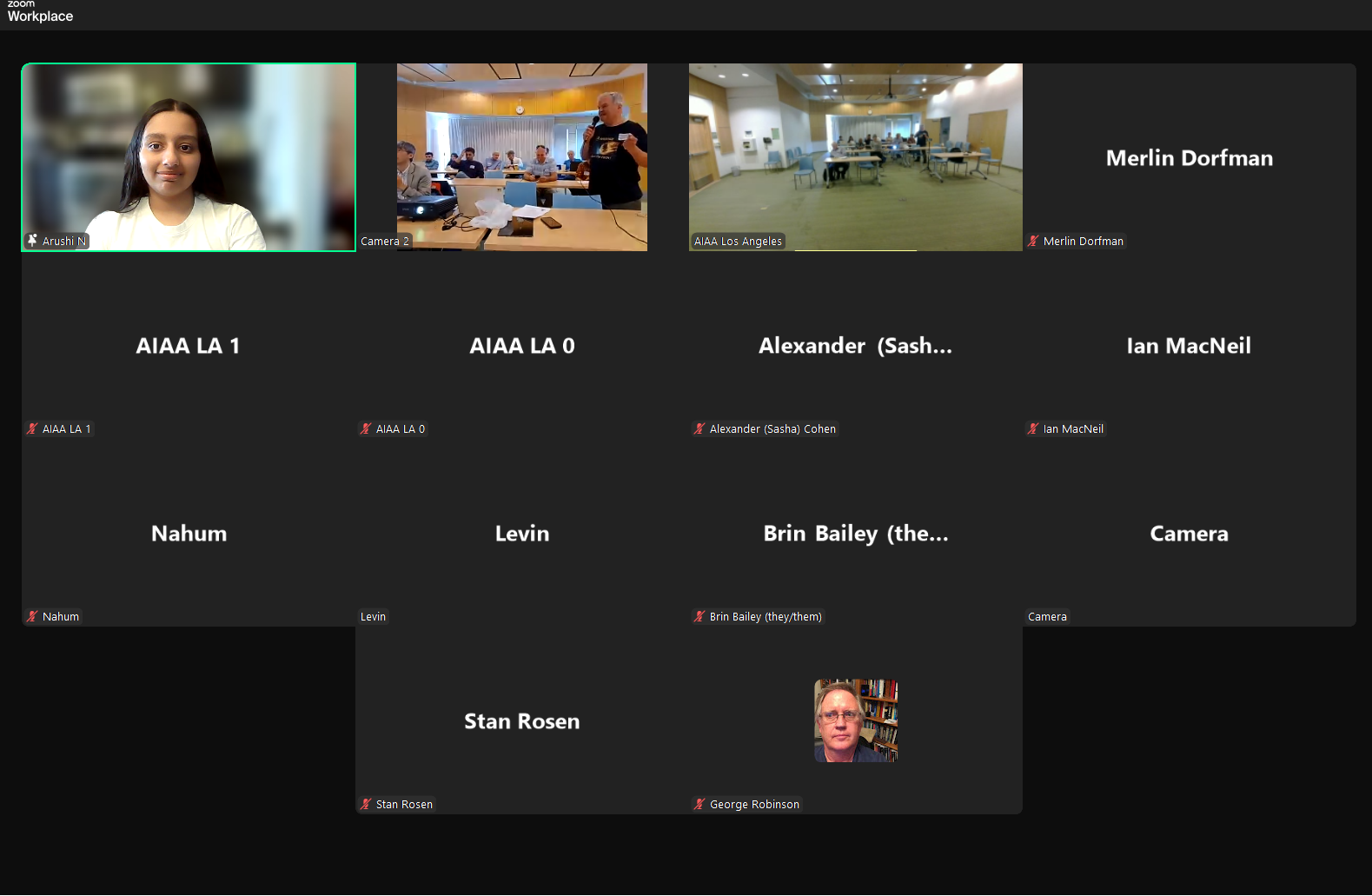
Presenting on PhAst at the Mini Planetary Defense Conference 2024
4. Asteroid Characterization
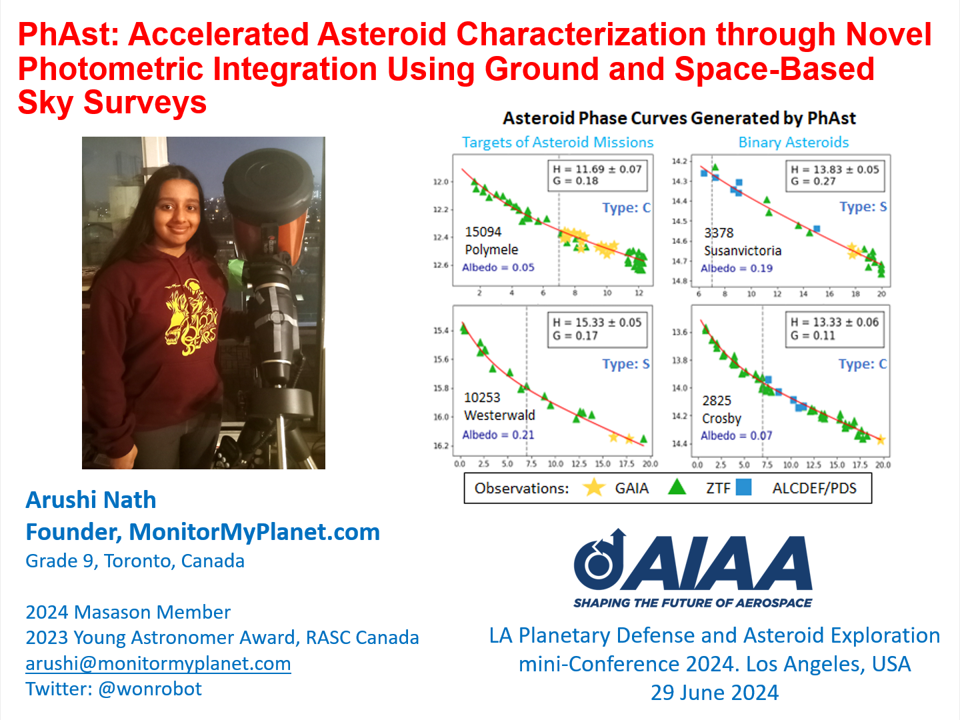
PhAst: Accelerated Asteroid Characterization: Focusing on a novel methodology combining serendipitous and dense photometric observations.
Rocks in Space with Radar: Covering radar observations of near-Earth asteroids.
5. Innovative Concepts and Future Technologies
Introducing the Planetary Sunshade: Discussing a conceptual planetary sunshade to address climate crisis symptoms.
From Ozone Layer to Planetary Defense: Lessons from the Montreal Protocol.
6. Computational and Simulation Approaches
Ground Effects Simulations of Terminal Asteroid Disruption via Fragmentation.
Hydrocode Simulations of Asteroid Disruption and Deflection.
My Presentation: Accelerated Asteroid Characterization Using PhAst
Asteroid Discovery vs. Characterization: The pace of asteroid discovery surpasses the rate at which their physical properties can be analyzed, posing a challenge for planetary defense and understanding the solar system’s evolution.
Phase Curves: Phase curves, crucial for asteroid characterization, have been generated for only a few thousand of the 1.3 million known asteroids due to the need for multiple phase angle observations over several years.
PhAst Methodology: PhAst integrates sparse photometric observations from sky surveys with dense observations from professionals and citizen scientists. The algorithm generates phase curves to determine geometric albedo, composition, absolute magnitude, rotation period, and mutual orbital period for binary asteroids.
Testing on Didymos: PhAst was tested on asteroid Didymos, the target of NASA’s DART mission, accurately determining its albedo, rotation period, mutual orbital period, strength, size, and taxonomy.
Large-Scale Analysis: PhAst was used to generate phase curves for over 2100 asteroids in 100 hours on a home computer, providing valuable data to the binary asteroid working group and gaining insights into asteroid migration during solar system evolution.
Citizen Scientist Engagement: Open-source PhAst training modules have been developed to empower citizen scientists to contribute to asteroid characterization and planetary defense.
Key Points from My Presentation
Questions from the Audience
The presentation was well-received, prompting several questions from the audience, related to:
Telescope Equipment: The types of telescopes and equipment used in my observations.
Past Research on Apophis: My previous work related to the Apophis asteroid.
Future Goals: My future research directions and goals in asteroid studies.
Conclusion
The conference provided an excellent platform to share my research and interact with other experts and enthusiasts. The feedback and questions from participants were invaluable, helping to shape the future direction of my work in planetary defense and asteroid exploration. I thank the conference organisers, including Kenneth Lui and Nahum Melamed for giving me an opportunity to participate and speak at the conference.
2025 Third Grand Award, International Science and Engineering Fair, USA. 2023 Second Prize Winner – European Union Contest for Young Scientists (EUCYS). Best of the Fair Award, Gold Medal, Top of the Category, Youth Can Innovate, and Excellence in Astronomy Awards at Canada Wide Science Fair 2023 and 2022. RISE 100 Global Winner, Silver Medal, International Science and Engineering Fair 2022, Gold Medal, Canada Wide Science Fair 2021, NASA SpaceApps Global 2020, Gold Medalist – IRIC North American Science Fair 2020, BMT Global Home STEM Challenge 2020. Micro:bit Challenge North America Runners Up 2020. NASA SpaceApps Toronto 2019, 2018, 2017, 2014. Imagining the Skies Award 2019. Jesse Ketchum Astronomy Award 2018. Hon. Mention at 2019 NASA Planetary Defense Conference. Emerald Code Grand Prize 2018. Canadian Space Apps 2017.




 HotPopRobot