Arushi Nath, 14 years. Toronto, The 2023 Starfest happened in the River Place Campground in Ayton, Ontario, from 17 to 20 August. Starfest is Canada’s largest annual amateur astronomy conference […]
Arushi Nath, 14 years. Toronto,
Met My Telesope at the Riverplace Campground
The 2023 Starfest happened in the River Place Campground in Ayton, Ontario, from 17 to 20 August. Starfest is Canada’s largest annual amateur astronomy conference and star party organized by North York Astronomical Association (NYAA). Each year, it attracts hundreds of astronomy enthusiasts, astrophotographers, visual observers, citizen scientists, learners, and their supportive family members.
This year, for the first time, I was one among them!
I heard about Starfest through social media while searching for communities undertaking photometry of variable stars and exoplanets and decided to attend it.
Camping under the Dark Skies
I was just back from a two weeks wilderness summer camp, so I already had all the gear in easy reach for camping under the dark skies at the River Place Campground. My Dad required very little convincing as he would get to cook a meal over the camping stove.
I had planned to arrive on 17 August – the first day of Starfest. Unfortunately, looking at the weather warning of thunderstorms and rain that night, I decided to reach there the next day.
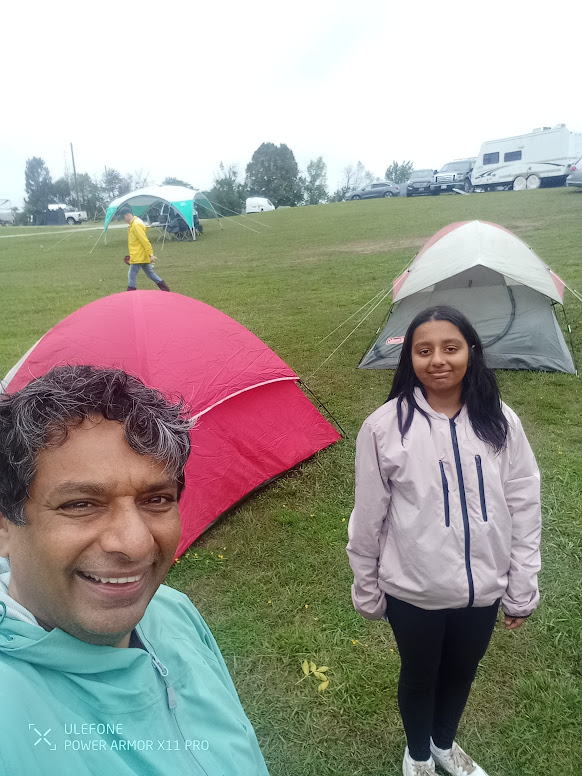
In Front of the Camping Tent, I Set Up
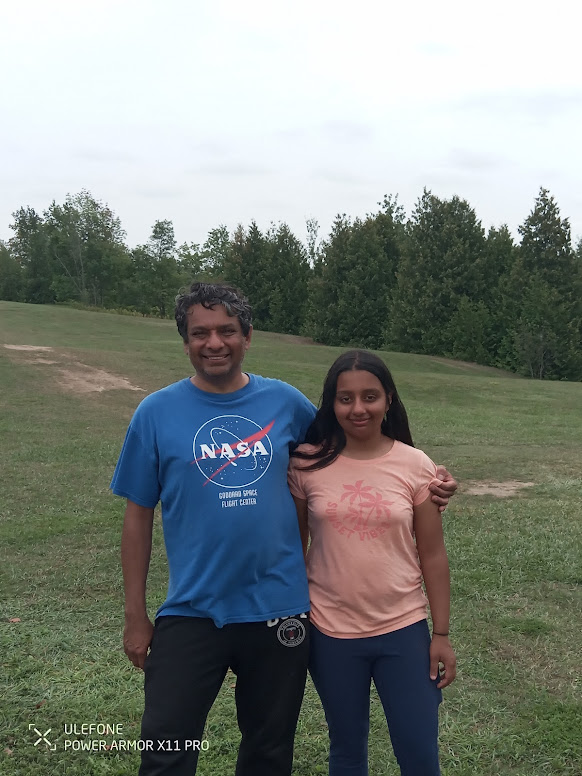
I, alongside my Dad, arrived at the campsite at noon on 18 August. The campground was beautiful and very well maintained. There were already hundreds of tents and trailers set up. But as the field was huge, abundant space was still available for camping. In almost 40 years of Starfest, no one has ever been turned back due to a lack of camping space. I decided to camp in the 800 area of the campsite as it seemed in the middle of everything. It was close to washrooms, the outdoor and indoor conference space for talks, and the food truck. Even though it was windy, I set up my tent nicely and arranged my personal, cooking and observation gear in less than an hour. I was then ready to explore and experience everything Starfest had to offer – and there was a lot!
Learning from the Community
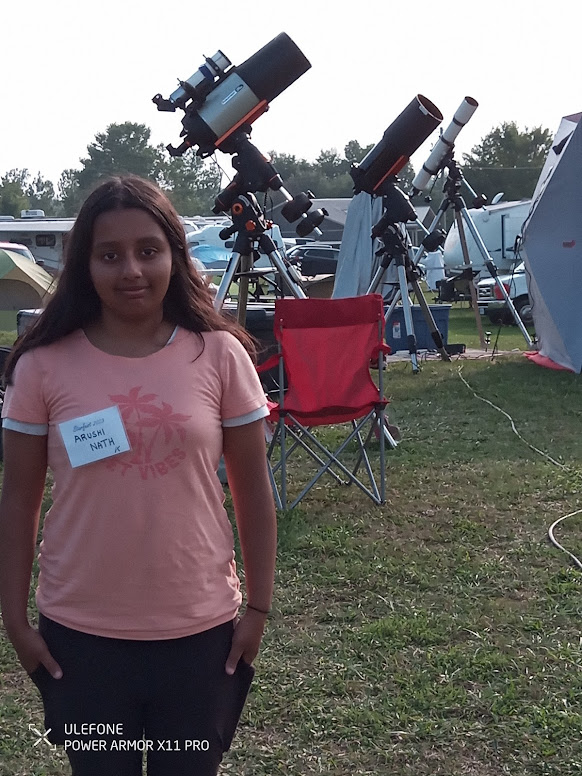
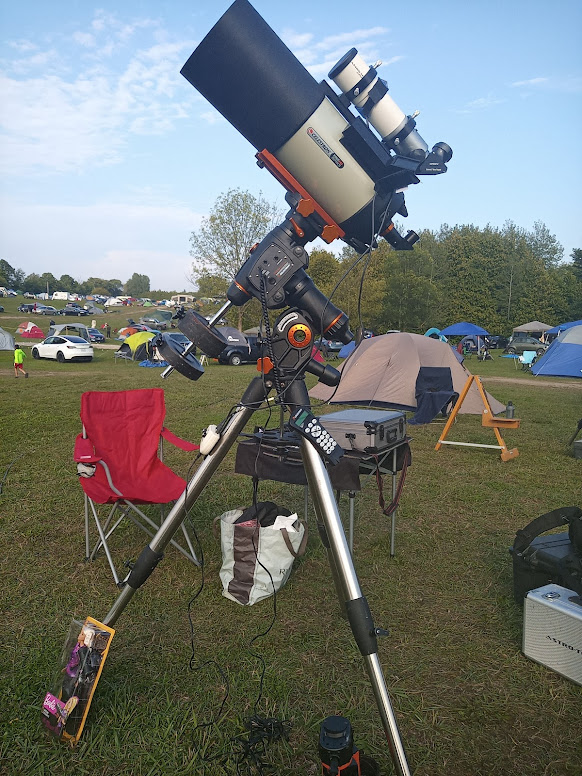
There were hundreds of telescope rigs set up throughout the campground. There were reflecting telescopes, refractor telescopes and everything in between. Some rigs were smaller than me, but most were taller than me, and in some cases, even the mounts were as tall as me. There were Dobsonians, Alt-Az, Wedges and Equatorial mounts. While most telescopes were store-bought and customized, some were hand-made, including their wooden structure and mirrors made by grinding glasses. There was even a lecture at Starfest by Frank Dempsey on amateur telescope-making! These telescopes had different instruments attached to them, including finder scopes, auto guiders, cameras, and filter wheels. Some telescopes were meant purely for visual astronomy and usually had comfortable chairs, star charts, and observation logs beside them. But many were aimed at astrophotography.
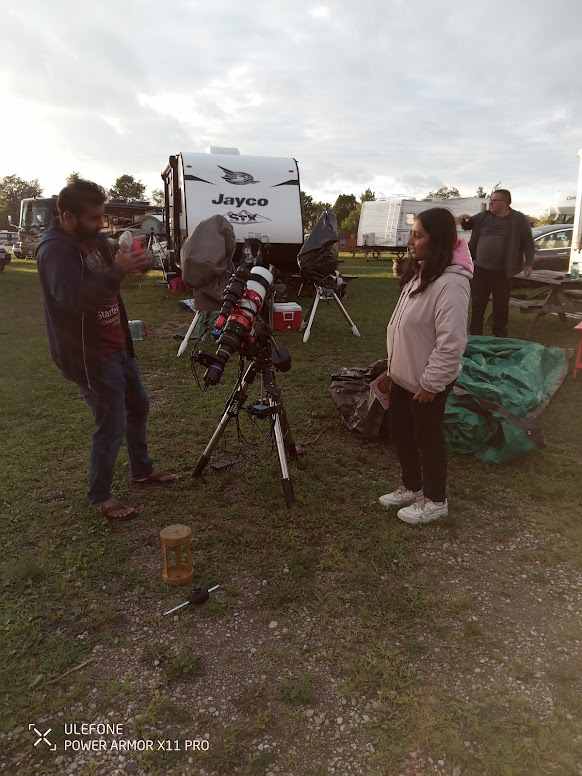
I enjoyed checking out these telescopes and learning about them. Everyone was super kind and generous in sharing details about their telescopes and what they planned to observe with them. I peeked through many of these telescopes and asked them about their gear, the software they used, their observation techniques, the scientific measurements these scopes were capable of, and how they acquired their astronomy knowledge. Many of them invited me to come back at night during observation time to check their scopes in action and peek through them. And I took upon their offers.
Learning About Camera Configuration and Observation Techniques from a fellow Starfest participant: Shail Choksi
Learning from the Talks
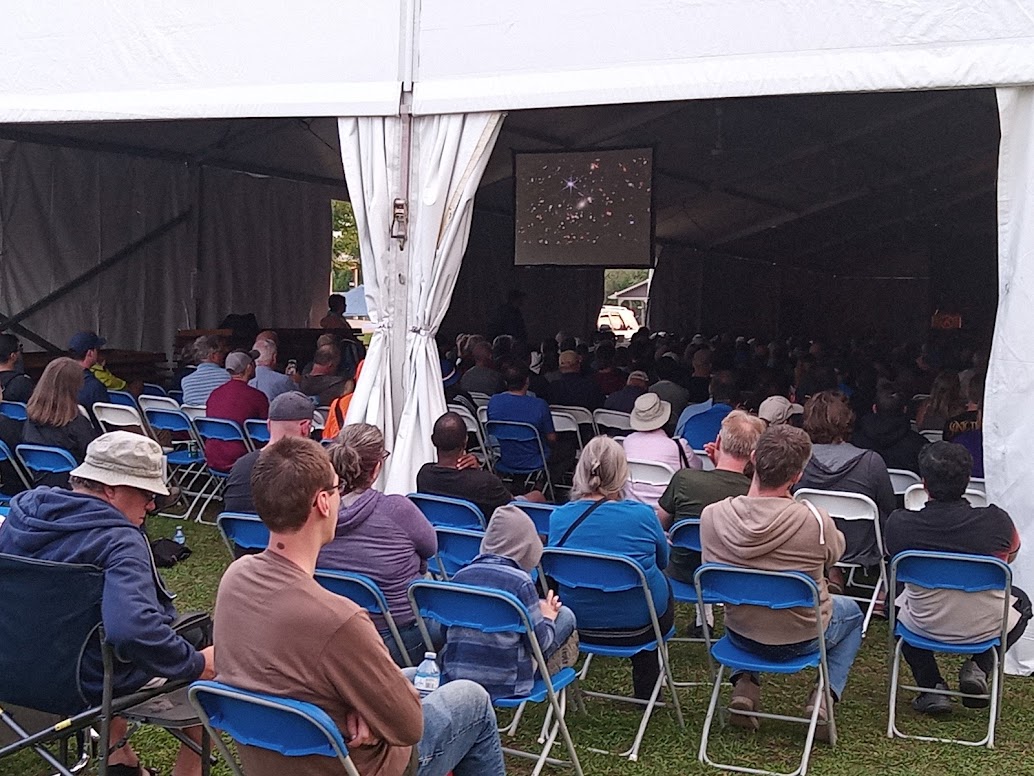
During the daytime, there were several talks and workshops organized by Starfest. These happened in two places: the outdoor tent and the conference room. The talks covered a range of topics for beginners and intermediate observers. They ranged from amateur telescope-making to astrophotography in the city, photographing the total solar eclipse 2024, Canada’s upcoming Lunar Rover Mission, and dark matter and neutrinos.
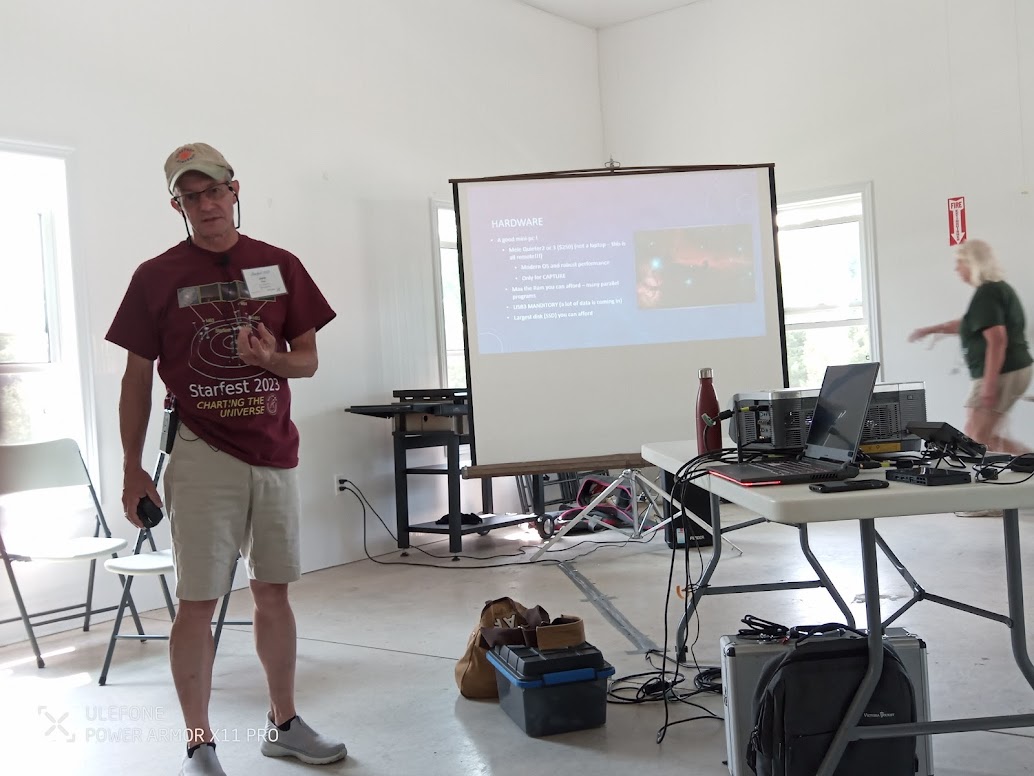
Attending Workshop on Automated Dual Scope Imaging and Sequencing with N.I.N.A. and I.N.D.I by Jamie Flinn
I attended many talks of interest to me. These included those on the Fred Young Submillimeter Telescope (Michel Fich), Astrophotography in the City (Ben Law), Product Development from Napkin to Reality (Jeff Simon), Golden Age of Backyard Astronomy (Wayne Parker), and the workshop on Automated Dual Scope Imaging and Sequencing (Jamie Flinn). I got the chance to learn about the NINA and INDI software, which are very useful for controlling every aspect of your telescope camera observations, from calibration images to images of celestial objects you want to observe. You could set specifications like exposure time, filters and wait time and use the camera in your guide scope to perform dual-scope imaging. Now I will have to research how to adapt the software to automate some of my long-duration photometry measurements.
At every talk, there was an opportunity to ask questions to the presenters, and I took advantage of that. Some of the questions I asked were how using different filters affected the signal-to-noise ratios of the images, why air-cooled cameras were needed for short-duration exposures, and how the focal reducer worked to improve observations.
I also attended the Terence Dickinson Tribute and the Memorial Keynote talk by Dr. Katie Mack on a Map of Cosmic Time on the last day of Starfest. I also got a chance to talk to Dr. Mack during the evening to learn more about her ongoing research. I also shared with her my projects on asteroid astrometry and asteroid photometry which won me the Top Award at the 2023 and 2022 Canada-Wide Science Fair- becoming the first back-to-back award winner in 34 years and the youngest ever to do so. More details on my website www.MonitorMyPlanet.com.
Full House for the Katie Mack Talk on the Last Day
Interacting with Telescope Vendors
There were also several commercial vendors putting their astronomy-related products on display and sale. It was educational to see the possibilities of imaging and science possible through smaller aperture telescopes in the hands of the general public. Backyard astronomy attracted new users during the Covid-19 pandemic making it more diverse. I chatted with the vendors to get their recommendations on cameras and filters I could use to undertake photometry measurements of exoplanetary transits with higher signal-to-noise ratios using small aperture telescopes.
My Observation Gear
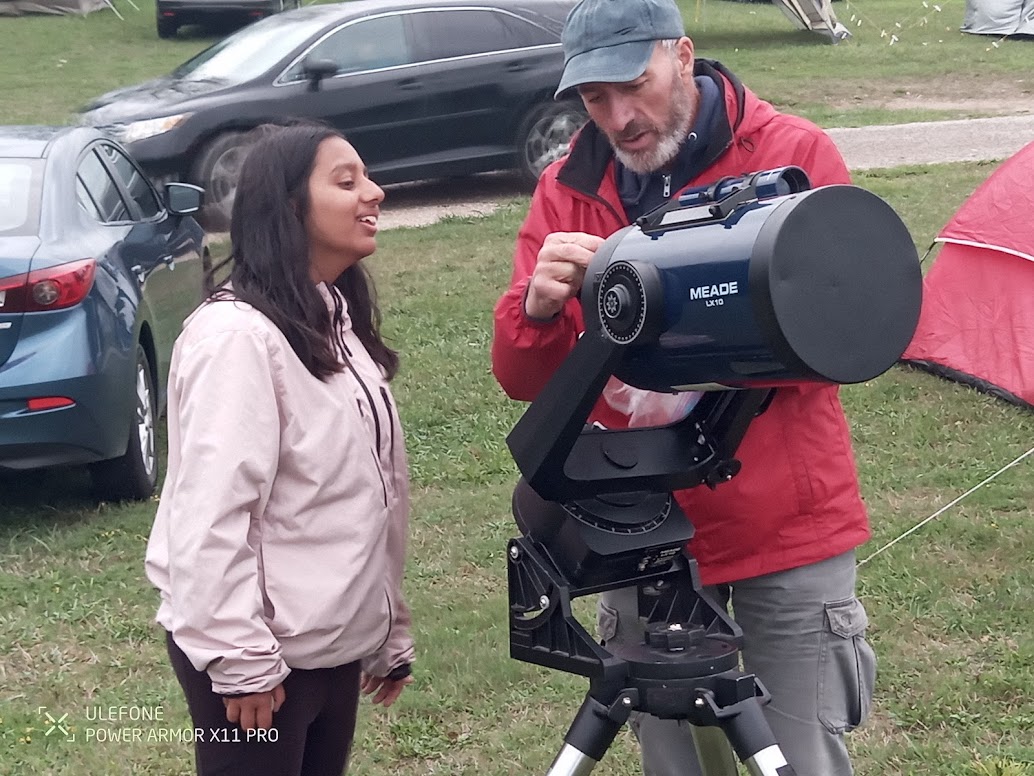
In terms of observation gear, I travelled light. I only carried a pair of binoculars, a NexImage5 camera and a Star Analyzer 100 for two reasons. First, I used a mix of public and private transit to reach the campground, so I had to keep the gear minimal. Second, I took advantage of the loaner telescope offered by the Royal Astronomical Society of Canada, Toronto, which allows a member to check out a telescope for two weeks. That telescope was a manual 8-inch Meade telescope fitted on a wedge. Frank Dempsey was kind enough to give me several short hands-on training sessions on how to use the telescope, namely how to set it up, orient it using Polaris, use different eyepieces, protect it from dew, and park it at the end of the observations.
I had always used an Alt-Az telescope mount before. However, the wedge allows you to tilt the telescope’s azimuth axis to track stars as they move in an arc around the celestial pole. It is handy as I planned to experiment with taking photometric and spectroscopic observations of some variable stars. The wedge would ensure I can smoothly track the variable star and comparison stars during multiple photometry exposures ranging from 5 to 15 seconds.
Getting an Onsite Tutorial by Frank Dempsey on How to Configure a Telescope on an Equatorial Mount/Wedge
My Photometric and Spectroscopic Observations
The first night, the sky was clear, with almost no wind and clouds. I started by aligning the telescope using Polaris. I had to ensure that what I saw in the finderscope was what I got in the telescope’s eyepiece. It called for adjusting the finderscope screws to get a good calibration. As this was my first time using a new mount, there was a learning curve, and I enjoyed learning this new skill.
Once the scope was calibrated, I switched on its tracking motors. I pointed the telescope at different stars in the Big Dipper and Bootes constellation to see how good my calibration was. Unfortunately, my calibration was not perfect as I had put my telescope on a slight slope, and the legs of the telescope mount were non-adjustable. It meant that objects in the eyepiece started to drift out after a short time. But I could take shorter exposures while the object was still in the field of view.
Spectroscopy Measurements of a Variable Star using Star Analyser 100
I enjoyed my first independent photometry observations so much that I lost track of time. I forgot one important rule: I should not let dew form on the telescope and finderscope mirrors. As the ground was still wet from the previous day’s rain, dew formed quickly. I switched on the dew heater, and luckily in about 30 minutes, most of the dew had cleared up from the gear, and I could resume my observations.
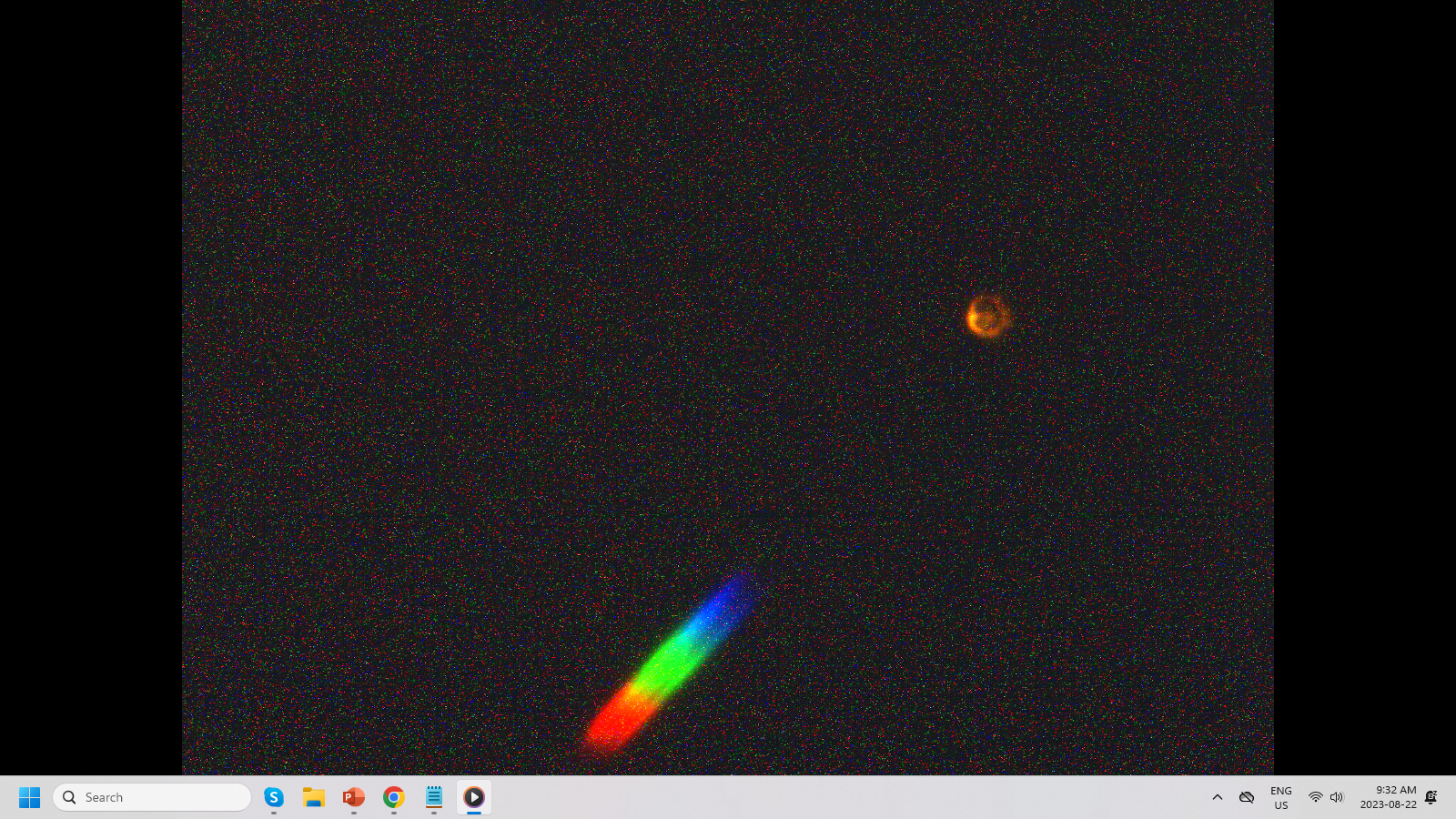
After getting a few photometric observations, I fixed my star analyzer to the NexStar5 camera for spectroscopic observations of some of the stars in the Big Dipper constellation. As spectroscopic observations did not require long-duration exposures, I made several observations to analyze in detail after reaching home.
Analyzing Spectroscopic Data using RSpec Software
The second night started with a lot of cloud cover. As the night progressed, the clouds dispersed across the sky. It was a challenge to image stars that night since, half the time, clouds blocked them. The list of stars I had planned to observe was unfortunately blocked. So I switched to observing visible variable stars, including Seginus, a Delta Scuti-type variable star in the Bootes constellation: I could take only a few photometric measurements. For the remainder of the night, I decided to visit the telescopes of other observers to learn about the observations they were taking.
Observations from Other Telescopes
I looked through many other telescopes at Starfest. I saw several deep sky objects like the Ring Nebula, Dumbbell Nebula, Swan Nebula, Whale Nebula, Andromeda Galaxy, and many more. Seeing how vibrant the nebulae looked through narrowband filters like oxygen and nitrogen fascinated me. I also observed several planets through different eyepieces and magnifications, including ever-favourite Saturn and its rings, Jupiter and its four moons, and outer planets Neptune and Uranus.
Interestingly, I also met another variable star observer (Andy Beaton) and got an opportunity to learn new skills. These included learning to visually estimate the brightness of variable stars based on comparison stars in the same field of view using the AAVSO variable star charts.
So Many Telescopes to View From at the Starfest 2023
Meeting Old Friends and Making New Friends
The Starfest was a fantastic opportunity to meet so many of my old astronomy friends who have been a part of my astronomy journey but did not get to meet because of the pandemic. It was also an opportunity to strike new friendships and collaborations, learn new astronomy skills, and share information about exciting resources and events of interest. What a wonderful community NYAA brings together.
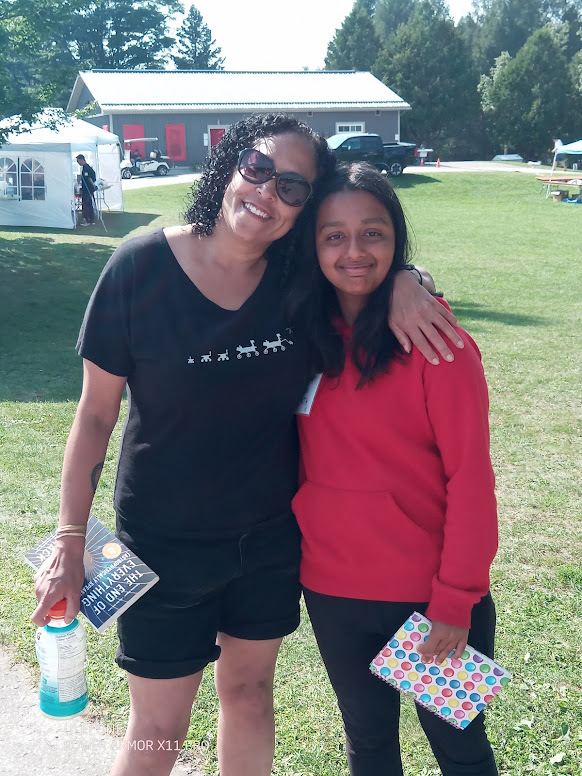
Meeting Nicole Mortillaro – several years later, because of the pandemic
And Nicole’s Cool Telescope Rig – I observed through it on the second night!
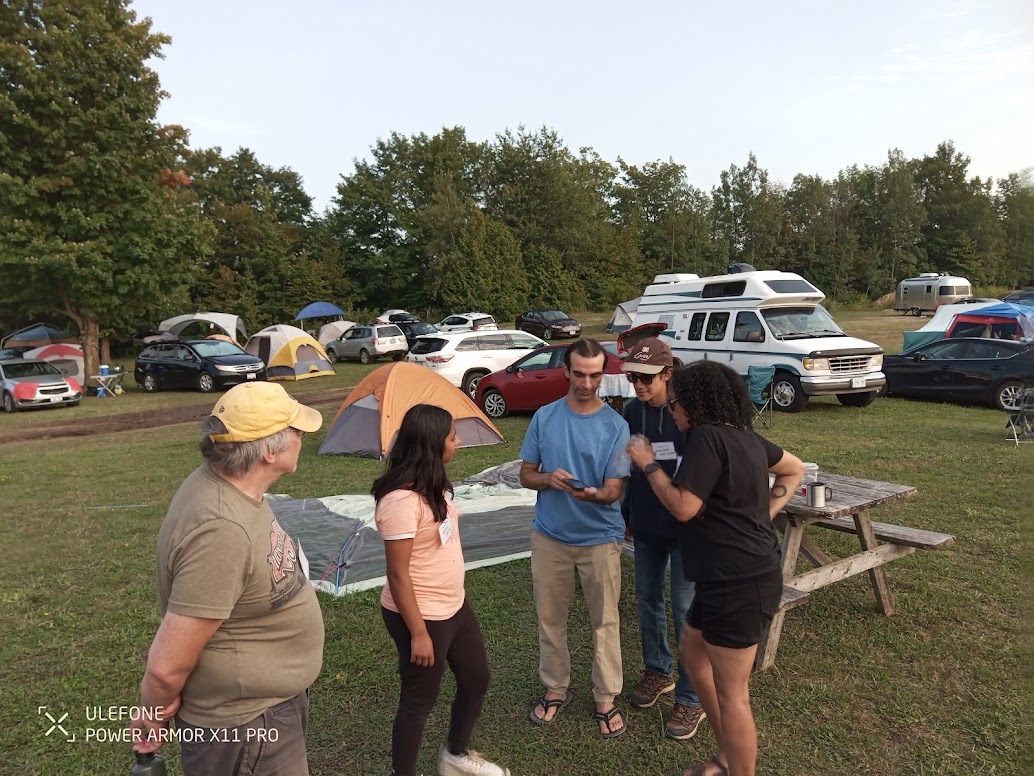
Meeting new friends at the Starfest 2023 – the community is amazing
Thanks for the Starfest
I want to thank the organizers of NYAA for making the Starfest a success. They had worked hard over the months to make it possible. It was the first Starfest since the pandemic in 2020.
It was a fantastic learning, camping, and observing opportunity for me under the dark skies. I met many new people and looked at the sky through different scopes. I hope to be there for Starfest 2024!
Bonding Over Food and Laughter with Other First-Time Starfest-ers!
It was Great to talk with you at the lecture and so glad to see another RSpec user…. spectrographs are fun! Keep up drive as you have the right mind set for this hobby – you can always ask questions via the NYAA fireball and being an NYAA member is fabulous way to expand your knowhow and share what you have been doing…enjoy the rest of your stargazing summer!
Jamie Flinn
Hello Jamie,
Thanks for delivering such a wonderful workshop on dual-scope imaging using NINA and INDI and NYAA Starfest 2023. I learned a lot from it. I will be building up my learnings on automating the observations in the next few days and will reach out to the NYAA fireball forums in case of issues. Arushi
2025 Third Grand Award, International Science and Engineering Fair, USA. 2023 Second Prize Winner – European Union Contest for Young Scientists (EUCYS). Best of the Fair Award, Gold Medal, Top of the Category, Youth Can Innovate, and Excellence in Astronomy Awards at Canada Wide Science Fair 2023 and 2022. RISE 100 Global Winner, Silver Medal, International Science and Engineering Fair 2022, Gold Medal, Canada Wide Science Fair 2021, NASA SpaceApps Global 2020, Gold Medalist – IRIC North American Science Fair 2020, BMT Global Home STEM Challenge 2020. Micro:bit Challenge North America Runners Up 2020. NASA SpaceApps Toronto 2019, 2018, 2017, 2014. Imagining the Skies Award 2019. Jesse Ketchum Astronomy Award 2018. Hon. Mention at 2019 NASA Planetary Defense Conference. Emerald Code Grand Prize 2018. Canadian Space Apps 2017.







 HotPopRobot
It was Great to talk with you at the lecture and so glad to see another RSpec user…. spectrographs are fun! Keep up drive as you have the right mind set for this hobby – you can always ask questions via the NYAA fireball and being an NYAA member is fabulous way to expand your knowhow and share what you have been doing…enjoy the rest of your stargazing summer!
Jamie Flinn
Hello Jamie,
Thanks for delivering such a wonderful workshop on dual-scope imaging using NINA and INDI and NYAA Starfest 2023. I learned a lot from it. I will be building up my learnings on automating the observations in the next few days and will reach out to the NYAA fireball forums in case of issues. Arushi